Scary Teacher 3D
- 4.2
- Rating
- 100.00M
- Installs
- Free
- Price

 Analysis by App-foxy
Scary Teacher 3D is the kind of simulation game I install when I want something light, mischievous, and easy to understand within a few minutes. I play as a student trying to outsmart a frightening teacher, using the environment and the objectives to create trouble without being caught. That basic idea gives the game an immediate hook: there is no complicated backstory to study before the fun begins, and the playful suspense makes the first sessions surprisingly easy to enjoy.
After spending time with it, my opinion is more balanced than the simple premise suggests. The game is entertaining when I treat it as a short-session challenge, but its long-term appeal depends heavily on whether I enjoy repeating familiar patterns, experimenting with timing, and working through a mischievous series of tasks. It is free to play, aimed at a Teen audience, and developed by Z & K Games. Its broad audience is understandable, although popularity alone does not make every part of the experience equally strong.
How the first week feels in practice
The opening appeal comes from the contrast between an ordinary-looking school setting and the player’s unusual goal. Instead of attending lessons or solving conventional puzzles, I move through the teacher’s space looking for a way to complete an objective and escape the consequences. That gives each early attempt a small stealth-game flavor, even though the overall presentation remains accessible and cartoonish rather than genuinely frightening.
You May Also Like

 Pandora - Music & Podcasts
Pandora’s Music Is Easy to Start, but Harder to Recover
Pandora’s strength is its low-effort path from a seed to a station. Its weak spot is how much confidence it asks you to place in connection, setup, and quiet recovery.

 8 Ball Pool
 Is Built on Rivalries, Rematches, and Routine
A close look at the rivalries, rematches, shared routines, and unanswered safety questions that turn a quick pool match into a persistent mobile community.

 Samsung Music
’s Quiet Strength Is Playing What You Already Own
Its reach comes less from spectacle than from dependable access to a personal library. That simplicity is both the app’s strongest retention engine and its ceiling.

 AccuWeather: Weather Radar
AccuWeather Review: A Quick, Clear Forecast for Everyday Decisions
For everyday plans, the best forecast is the one you can understand quickly. AccuWeather makes rain timing, radar, and local conditions easy to act on, with a few trade-offs.

 Hill Climb Racing
Why Hill Climb Racing Still Turns Crashes Into One More Run
A tiny car, a bumpy hill and one more upgrade: Hill Climb Racing keeps resurfacing because its simple chaos makes every near-miss feel personal.

 AliExpress - Shopping App
AliExpress Makes Global Shopping Feel Personal, but Shoppers Bear the Risk
AliExpress turns a global marketplace into a pocket-sized discovery engine. Its reach is useful, its shopping loop compelling, and its trade-offs easy to miss.
More From Our News Desk
View All News


I particularly like how quickly the game communicates its central rhythm. I enter an area, inspect what is around me, decide what action might help, and then react when the teacher’s presence turns a simple plan into a chase. The best early moments happen when I stop rushing and pay attention to the layout. A doorway, a hiding place, or an object that initially looks decorative can become important once I understand what the task is asking me to do.
The first sessions are also helped by the game’s sense of humor. The title promises a scary teacher, but the experience is closer to playful cartoon mischief than serious horror. That makes it suitable for players who like tension without wanting a dark atmosphere. I would still respect the Teen content rating, especially when choosing it for a younger player, but the tone is more silly and theatrical than disturbing.
One useful habit is to explore before committing to an attempt. I used to focus only on the obvious route, then wondered why a task became difficult when the teacher appeared. A slower first look often reveals safer movement options and lets me form a plan rather than improvising every second. This is one of the game’s quiet strengths: it rewards observation, not just quick fingers.
The controls are easiest to appreciate when I keep my movements deliberate. Fast, nervous inputs can make a narrow escape harder, particularly when I am already reacting to the teacher. I found that short sessions work better when I treat each attempt as information gathering. If I fail, I try to remember what triggered the pursuit, which route was too exposed, and whether I had entered the area without a clear exit.
That approach also reduces the frustration that can appear during the first week. A failed attempt does not have to feel wasted if I use it to learn the environment. The game’s appeal is strongest when I am curious about the next solution, not when I expect every objective to be immediately obvious.
For a realistic everyday scenario, I can see myself playing it during a short break, on a commute, or while waiting for an appointment. It does not demand the kind of uninterrupted attention I would give a long story-driven adventure. I can play for a while, stop after a task, and return later with a reasonable idea of what I was doing. That makes it more convenient than many larger simulation games that require long sessions to feel rewarding.
There is also a social use case, although the game itself remains a solo experience. I can hand the phone to a friend and let them suggest a route or watch an attempt. The teacher’s reactions and the consequences of a bad plan create natural conversation. It is not a deep multiplayer substitute, but it works as a casual “what would you do here?” game when people are sharing a screen.
The current version is 9.3, and the game requires Android 6.0 or later. Those details make it approachable for people using older compatible Android devices, although actual comfort will still depend on the phone’s screen, controls, and general performance. I would check the device before expecting a smooth experience, especially if the player dislikes cramped touch controls.
Its scale is clear from its audience: the game has passed one hundred million installs and holds an average rating of 4.2 from around two million ratings. Those figures explain why it remains visible among mobile simulation games, but my own recommendation would still depend on taste. The first-week experience is appealing if you enjoy stealthy pranks, environmental problem-solving, and short bursts of tension. It is less convincing if you want realistic simulation, a serious horror story, or a highly social game.
What makes the novelty work
The central fantasy is more specific than a generic chase game. I am not simply running away from an enemy; I am trying to make a plan inside a familiar domestic-school setting while avoiding the person who controls it. That relationship gives the objectives their personality. The teacher is not just an obstacle placed in a maze, and my actions feel like deliberate acts of rebellion rather than random movement between checkpoints.
I also appreciate the way the game encourages me to think in sequences. A successful attempt often depends on doing things in the right order, preparing an escape, and resisting the temptation to interact with the first interesting object I see. This creates a small but satisfying planning layer. It is not a complex simulation, yet it can make a simple task feel clever when I finally understand the intended rhythm.
My strongest practical tip is to separate scouting from execution. On the first visit to a new area, I look for routes and possible hiding spots without worrying too much about completing the objective. On the next attempt, I use that knowledge to move with purpose. This is more reliable than repeatedly charging forward and hoping the teacher does not notice.
Another useful tactic is to avoid treating every chase as a reflex test. When the teacher starts pursuing me, panic usually causes worse decisions. I try to remember the nearest safe direction and keep the camera or viewpoint under control. The game becomes less irritating when I see pursuit as part of the plan rather than an unexpected interruption.
These small techniques are not advertised as advanced systems, but they make a real difference to the feel of play. They turn the experience from random trial and error into a simple loop of observation, execution, failure, and adjustment. That loop is the main reason I kept returning during the first week.
What remains after the first month
The harder question is whether the game earns a permanent place on my phone after the initial surprise fades. My answer is conditional. It has recurring value for players who enjoy completing objectives, replaying situations to improve their approach, and taking pleasure in the teacher’s reactions. It has less lasting value for anyone who mainly wants a fresh story or a constantly changing world.
Unlike a conventional life simulation, this is not a game I use to build a routine, manage a character over a long timeline, or watch a world develop naturally. Its simulation label describes the setting and interaction style more than a detailed model of school life. That distinction matters. Someone searching for farming, city building, social management, or realistic daily schedules would probably be happier with a different kind of simulation.
Compared with a typical horror game, the experience is lighter and more puzzle-oriented. There is tension, but the humor and exaggerated presentation keep the mood from becoming oppressive. Compared with a standard stealth game, the systems are easier to grasp and the objectives are more immediate, although players seeking deep enemy behavior or highly flexible level design may find it limited.
Compared with other casual mobile games, its main advantage is that it gives me a concrete reason to move through each environment. I am not simply collecting points or waiting for a timer. I am trying to perform a prank-like task while managing the risk of being discovered. That goal creates more personality than many quick-play alternatives, even when the underlying interaction remains simple.
The month-to-month value therefore comes from mastery rather than endless variety. I can improve my routes, recognize warning signs sooner, and become more efficient at setting up an attempt. If I enjoy that kind of gradual familiarity, the game can remain a comfortable fallback. If I need a constant stream of new mechanics, the same structure may start to feel predictable.
In-app purchases range from $0.99 to $28.99 per item. Because the game is free to start, I would approach those purchases carefully and decide whether they solve a genuine problem for my play style. I do not think the best way to judge the game is by assuming that spending will create deeper gameplay. The core question is whether I already enjoy the available loop without feeling pressured to pay.
For me, the healthiest way to keep it installed is to use it as a small entertainment option rather than a main game. I might return when I want a quick challenge, when I am in the mood to revisit a favorite type of objective, or when I want to show someone the premise. I would not rely on it as my only mobile game for an entire month because its style can become familiar faster than a larger adventure or a more open simulation.
Maintenance, repetition, and everyday friction
The maintenance burden is fairly low in the practical sense. I do not need to manage a complicated economy, organize a large collection, or maintain a long chain of daily tasks to understand what I should do next. That simplicity is valuable when I want to open the game without preparing for a major session.
At the same time, low management does not mean zero friction. The main cost is mental repetition. I need to remember how the teacher reacts, which routes are exposed, and which actions are worth attempting first. Repeating a failed plan without changing anything quickly becomes tiring. The game rewards active attention, so it is not ideal when I want a completely passive distraction.
Touch controls can also affect the experience. Stealth depends on movement and timing, and small mistakes can feel more significant when the screen is crowded or my hand covers part of the action. I would recommend playing with the device held comfortably and keeping my movements measured. A player who prefers precise physical controls may find a controller-focused stealth game more satisfying.
Another maintenance issue is remembering where I left off. Because the game is built around individual objectives rather than a single continuous narrative, returning after a long break may not produce the same emotional pull as returning to a story with characters and unresolved plot points. I can still play, but the motivation is more mechanical: solve the next task, try a cleaner route, or revisit the prank-like challenge.
That is not necessarily a flaw. In fact, it makes the game easy to dip into. I do not have to replay a long cutscene or reconstruct a complicated plot before enjoying it. The trade-off is that the game may not create a strong reason to return every day. Its habit is occasional and playful rather than deeply routine.
I also think the Teen rating should be treated as a practical decision rather than ignored because the presentation is cartoonish. The premise involves fear, pursuit, and mischievous behavior toward a teacher. Families should decide whether that tone suits the player, especially if the player is sensitive to chase scenes or prefers calmer simulations.
Where the long-term fatigue comes from
The biggest source of fatigue is predictability. Once I understand the broad pattern of entering an area, searching for the right interaction, and escaping the teacher, some surprises lose their effect. The first successful prank feels inventive; later attempts can feel like another variation on a familiar routine.
Repetition is not automatically bad, because many games build their appeal around refining a repeated action. The issue is whether I enjoy the refinement itself. If I like optimizing routes and learning from mistakes, repetition becomes a challenge. If I mainly play for discovery, the same repetition becomes evidence that I should move on to something with broader systems.
The game can also test my patience when the objective is not immediately clear. Exploration is enjoyable when I feel I am uncovering a sensible solution. It becomes less enjoyable when I am checking every possible interaction without a strong clue about what matters. My best response is to slow down, inspect the environment, and avoid wasting attempts on random actions, but that still requires more patience than a purely casual arcade game.
The teacher’s presence creates tension, yet it can also make experimentation feel costly. I sometimes want to test an object simply to see what happens, but being discovered can interrupt that curiosity. This is a meaningful trade-off: the threat gives the game its identity, while the same threat can discourage relaxed exploration.
Players who want a strong narrative may also feel fatigue sooner. The premise is memorable, but it is not the same as a character-driven adventure with evolving relationships and emotional stakes. I enjoy the setup as a playful framework for tasks, not as a story I expect to carry me through a long campaign.
For that reason, I would skip it if my priority is realism, deep strategy, competitive play, or a simulation that keeps generating complex personal stories. I would also look elsewhere if I dislike games that rely on repeated attempts and gradual learning. The game is a better match for someone who enjoys a mischievous objective, a contained environment, and the satisfaction of finally making a risky plan work.
My long-term verdict
After the novelty fades, Scary Teacher 3D remains worthwhile as a compact, characterful simulation game, but I would not call it essential for everyone. Its strongest quality is the clear fantasy of outsmarting a threatening teacher through observation, timing, and environmental interaction. That idea is easy to understand, entertaining in short sessions, and distinctive enough to separate it from ordinary chase games.
I would recommend it to players who want a free mobile game with a playful horror flavor, simple stealth decisions, and objectives that can be tackled in manageable bursts. It is especially suitable for someone who enjoys learning a space, trying a plan, failing, and returning with a better route. The large audience and 4.2 average suggest that this formula has broad appeal, and I can understand why it has remained visible among Android games.
I would be more cautious with players who need constant novelty. The game’s lasting value is built around familiarity and improvement, not an endlessly changing simulation. Once I know the basic rhythm, I need to supply my own motivation by chasing cleaner solutions or returning for the atmosphere. That can be satisfying, but it is not the same as receiving a new reason to play every time I open the app.
My final recommendation is to treat it as a reliable side game rather than a permanent centerpiece. Install it when the idea of harmlessly outsmarting a scary teacher sounds fun, play with a patient scouting mindset, and judge the experience by how much you enjoy refining your approach. If that loop still feels amusing after several sessions, it has a good chance of staying installed. If the repeated setup begins to feel like work, a deeper stealth game or a more systems-heavy simulation will probably offer better long-term value.
The game earns its space through personality, not endless depth. That is exactly why I can recommend it honestly: it delivers a specific kind of mischievous mobile entertainment, while making its limits clear once the first-week surprise has passed.
FAQs for Scary Teacher 3D
01What is Scary Teacher 3D about?
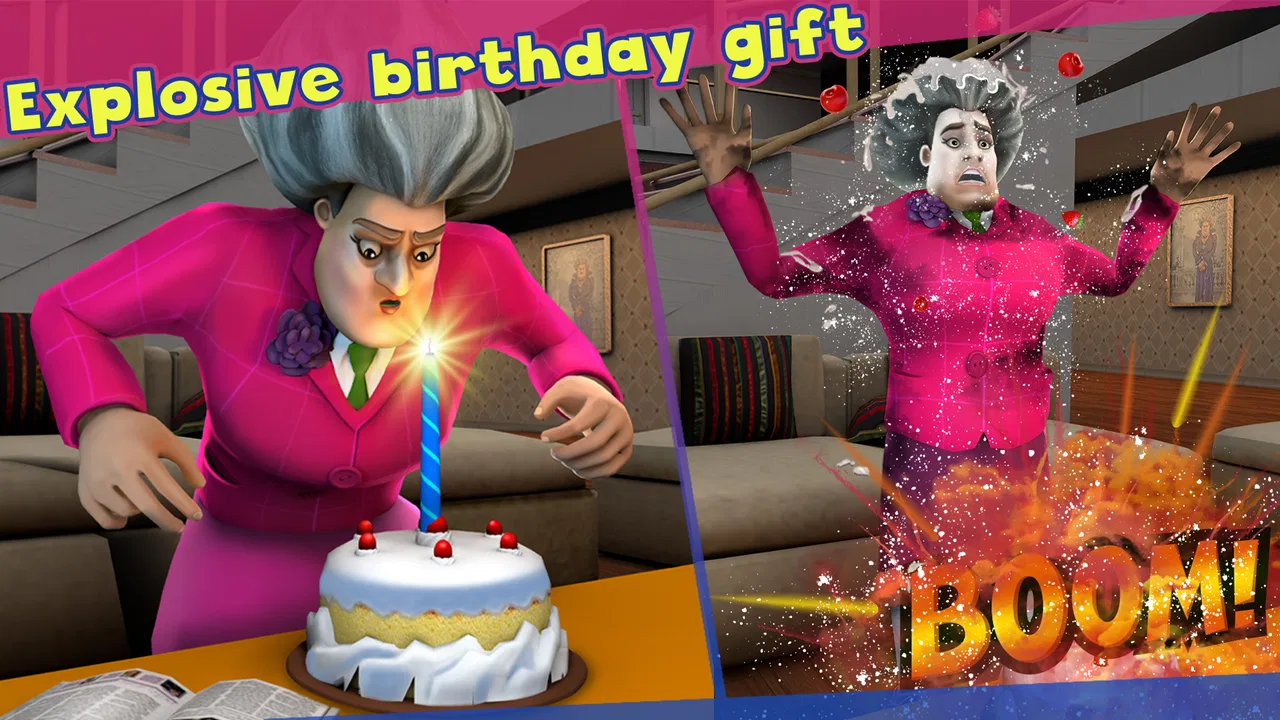
Scary Teacher 3D is a thrilling simulation game where players navigate through the home of a terrifying teacher, Miss T, to execute pranks and solve puzzles. The game combines elements of horror and humor, offering an engaging storyline across multiple levels. Players need to be strategic and stealthy to succeed.
02Is Scary Teacher 3D free to play?
Yes, Scary Teacher 3D is free to download and play on both Android and iOS platforms. However, it offers in-app purchases that can enhance the gaming experience. These purchases include additional levels, special items, and the removal of ads, making it more enjoyable for some players.
03What age group is Scary Teacher 3D suitable for?
Scary Teacher 3D is generally suitable for players aged 12 and above. The game contains mild horror themes and elements of mischievous behavior, which may not be appropriate for younger children. Parents should review the content to ensure it aligns with their family’s values and comfort levels.
04Are there any system requirements for Scary Teacher 3D?
To run Scary Teacher 3D smoothly, Android users need a device with at least Android 4.4, while iOS users require iOS 9.0 or later. Ensuring your device meets these specifications will provide a better gaming experience, with optimal graphics and performance across all levels.
05Can Scary Teacher 3D be played offline?
Scary Teacher 3D can be played offline, allowing users to enjoy the game without an internet connection. This feature is particularly useful for players who wish to save data or play in areas with limited connectivity. However, certain online features and updates may require internet access.
Pros
- Engaging storyline with unique challenges.
- High-quality 3D graphics enhance gameplay.
- Creative pranks keep the game interesting.
- User-friendly controls for easy navigation.
- Regular updates with new levels and features.
Cons
- In-app purchases can be costly.
- Ads can interrupt gameplay frequently.
- Requires a stable internet connection.
- Limited customization options for avatars.
- Some levels may feel repetitive.

Scary Teacher 3D
Gallery